 |
DVD VIDEO
ballet
compilations or
telecasts
starring various artists:
The
Astonishing Moiseyev
Dance Co., Vol 1 & 2
Moiseyev: His World of Dance
Vincente Fernández Flamenco Co.
From Granada to Jerez
Art of the Pas de Deux
all-star compliation
Art
of the Pas de Deux, Vol. 2
all-star compilation
Art of the Pas de Deux, Vol. 3
all-star compilation
Pas
de Deux
McBride, Olsen, others
Great Stars
of Russian Ballet, Vol 1 & 2
Great Stars
of Russian Ballet, Vol. 3 & 4
Stars
of the Russian Ballet
Ulanova, Plisetskaya,
Sergeyev, Zhdanov
Nina
Ananiashvili
& Int'l Stars, Vol. 1
Nina AnaniashviliI
& Int'l Stars, Vol. 2
compilations
& documentary
- alphabetically by artist:
Alonso, Alicia
Prima Ballerina Assoluta
Bruhn, Erik
Bell Telephone Hour
Bujones,
Fernando
with
Cynthia Gregory, Live
Chauviré, Yvette
France's Ballerina Assoluta
d’Amboise, Jacques
Portrait of a Great
American Dancer
Fracci, Carla
An Evening with
Gregory, Cynthia
with Fernando Bujones,
Live
Limón, José
Three Modern Ballets
Loudières,
Monique
Comme les Oiseaux - A Portrait
Malakhov, Vladimir
True Prince
Maximova, Ekaterina
Katia & Volodia
Nureyev,
Rudolph
Bell
Telephone Hour
Plisetskaya, Maya
Plisetskaya Dances
with Vasiliev,
Begak, Liepa
Swan Lake
with Bogatirev
The
Seagull
with Bogatirev
A Portrait
Tallchief, Maria
Art of
Vasiliev, Vladimir
Katia & Volodia
Verdy,
Violette
Violette & Mr.
B.
The
Artist Teacher
Alphabetically by Ballet
Anna Karenina
Plisetskaya, Godunov
Anna Karenina
Plisetskaya, Petukhov,
Anyuta
Maximova, Vasiliev
Le Baiser
de la Fée
Yatsenko, Malakhov
Carmen Suite Ballet
Plisetskaya, Fadeyechv,
Radchenko
Checkmate
Barbieri, Ashmole, Bintley,
others
Cinderella
Fonteyn, Somes,
Ashton, MacMillan
Don Quixote
Ananiashvili, Fadeyechev
Don Quixote
Pavlova, Gordeev. others
Enchantress, The
Zyryanova, Stepanov, Korzhakova,
Valyuta
Excelsior
Fracci, Bortoluzzi, Razzi, Telloli
Gaîté
Parisienne
Danilova, Franklin, Danielian
Gayne
Tuisova, Rumyantsev
Giselle
Kain, Augystyn
Giselle
Nureyev, Fracci
Giselle
Alonso, Vasiliev
Little
Humpbacked Horse, The
Plisetskaya, Vasiliev
Lieutenant
Kijé
Vasiliev, Struchkova
Marco Spada
Nureyev, Thesmar
Masquerade
Dolgushin, Smirnova, others
Mediterranea
Murro, Sutera, Carbone
Petrushka
Semenyaka, Elagin
Rakes Progress
Morse, Katrak, Reeder, others
Raymonda
Kolpakova, Berezhnoi
Rite of Spring
Galimullin, Tsoi
Romeo and Juliet
Maximova, Vasiliev
Romeo
and Juliet
Ulanova, Zhdanov
Seagull
Plisetkskaya, Bogatirev
Sleeping Beauty
Nureyev, Tennant
Sleeping Beauty
Fonteyn, Somes, Ashton
Spartacus
Vasiliev, Bessmertnova, Liepa
Spartacus
Vasiliev, Maximova, Liepa
Stone Flower
Maximova, Vasiliev
Swan Lake
Ananiashvili, Fadeyechev
Swan
Lake
Plisetskaya, Fadeyechev
Swan
Lake
Plisetskaya, Bogatirev
Massine's
Symphonie Fantastique
starring:
Erik Bruhn, Toni Lander,
and Stanley Williams
Royal Danish Ballet, 1948
Trapeze
/ Fragments of a Biography
Maximova, Vasiliev,
Liepa,
Timofeyeva, Aleksei Fadeyechev,
and others.
 | | | | | | | | | | | |
 | |  | |  | |  | |  | |  | |
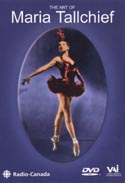

VAI DVD 4234, $34.95
"The Art of Maria Tallchief" combines two different programs that were previously available on VHS. 83 min. Color/B&W
Her Complete
Bell Telephone Hour Appearances
Maria Tallchief has long been recognized as one of the most accomplished
American-trained dancers of her time. Her superb technique, combined
with an innate musicality, lent a strong presence to her appearances,
most particularly to the many major roles created for her by
George Balanchine.
Tallchief made five guest appearances on the Bell Telephone Hour. Her partners included an appropriately starry assemblage of leading male dancers. The excerpts, ranging from the cool neoclassicism of Balanchine’s Allegro brillante to John Butler’s ardent Romeo and Juliet pas de deux, amply demonstrate the extraordinary versatility of this truly great American ballerina.
Adagio
from the "Scotch" Symphony
(with André Eglevsky) music: Mendelssohn;
choreography: George Balanchine
© The George Balanchine Trust
telecast of April 9, 1959
Grand
pas de deux from Don Quixote
(with Erik Bruhn) music: Minkus;
choreography: Marius Petipa
telecast of January 6, 1961
Pas
de deux from Flower Festival in Genzano
(with Rudolf Nureyev) music: Helsted & Paulli; choreography:
Erik Bruhn, after Bournonville
telecast of January 19, 1962
Allegro
brillante to
Tchaikovsky’s Third Piano Concerto
(with Nicholas Magallanes) music: Tchaikovsky; choreography:
George Balanchine
© The George Balanchine Trust
telecast of February 25, 1964
"Balcony
Scene" pas de deux
from Romeo and Juliet
(with Conrad Ludlow) music: Prokofiev;
choreography: John Butler
telecast of February 13, 1966
The
Bell Telephone Hour Orchestra
conducted by Donald Voorhees
Originally
produced for the
Bell Telephone Hour television series
USA, 1959/1961/1962/1964/1966, Color
Maria Tallchief in Montreal
These magnificent performances represent the earliest known video documents of one of the most important dancers of the century. Tallchief premiered many of Balanchine's ballets, including his Pas de Dix, which she dances here with André Eglevsky. Also included is an extended scene from Act II of Swan Lake (also with Eglevsky), with some new choreography by Balanchine. The video is rounded out by a performance of the Pas de deux from Les Sylphides with Royes Fernandez. Live telecasts from the archives of Radio-Canda, 1954-1963. Black & White.
telecast of March 3, 1963
Pas de deux from Les Sylphides (8:23)
Maria Tallchief, Royes Fernandez
music: Chopin; choreography: Michel Fokine
telecast of November 5, 1957
Pas
de dix (16:48)
Maria Tallchief, André Eglevsky,
and Corps de Balletmusic: Glazunov;
choreography: George Balanchine after Marius Petipa*
telecast of March 25, 1954
Swan
Lake - Scenes from Act II (13:37)
Maria Tallchief, André Eglevsky
music: Tchaikovsky;
choreography: George Balanchine after Lex Ivanov*
Orchestre
de Radio-Canada
under the direction of Jean Deslauriers
*
Pas de Dix, Scenes from Swan Lake Act II,
choreography by George Balanchine©
The George Balanchine Trust.
BALANCHINE is a Trademark of
The George Balanchine Trust.
In terms of physical presence, musicianship and razor-sharp technique,
Maria Tallchief remains the quintessential American dancer.
These performances, which include the earliest extant television
appearances by Miss Tallchief, capture those qualities with
stunning preciseness. Dance historians will take special
pleasure in the inclusion of George Balanchine's Pas de dix
with Miss Tallchief and André Eglevsky, principals
of the work's debut at New York's City Center less than two
years before Radio-Canada's filming. If the Pas de dix succeeds
in demonstrating Miss Tallchief's precision, authority and
superb point work, the excerpts from Les Sylphides and Swan
Lake exemplify the lyrical aspects of her dancing and the
sheer elegance of her line, qualities equally shared by her
Sylphides partner, Royes Fernandez.
|
Copyright © 2000
and 2001, Video Artists International & VAI Audio, All Rights Reserved
|
|||||